
SEO for Dermatologists, Done Differently: How One Dermatologist Turned Existing Videos Into Compounding Authority Assets That Continue to Drive Organic Traffic and AI Referrals
Quick Check
1/3
How often do you post educational content?
TL;DR
If you're a health or wellness professional creating educational and informative content on Instagram, TikTok, or YouTube to build your personal brand and business, you're already doing the hard part.
Creating short-form content is a labor of love. Between planning, filming, editing, writing captions, and engaging with your audience, we know it takes significant time and effort to show up consistently.
So why let all that work disappear in the algorithm after a few days?
One of the biggest gaps we see when working with health and wellness experts is this:
They're creating high-quality content, but they're missing a huge strategy piece that actually amplifies it, compounds it, and turns it into trackable traffic.
This dermatologist SEO case study demonstrates how existing educational content can become much more than a social media asset. By transforming short-form videos into a connected ecosystem of search-optimized resources, we created a compounding source of organic visibility across Google, AI platforms, and the practice's website.
In just 90 days, the strategy delivered measurable business results:
- Increased organic clicks by 403% in just 90 days
- Increased search impressions by 1,051%
- Generated referral traffic from AI platforms like ChatGPT
- Drove more qualified patient inquiries and new bookings
While using his library of already recorded assets.
If you:
- Already create educational or informative content
- Want to increase website traffic and visibility
- Are looking to attract more qualified inquiries or bookings
- Have expertise, but aren't seeing it reflected in search
- Want to capitalize on AI visibility
Then keep reading to see how we build Authority Systems that transform educational content into discoverable assets that signal trust and expertise to Google, AI, and your future patients long after you hit publish.
The Problem with Social-First Content Strategy
Social media is an incredible way to educate, build trust, and grow an audience. But it's also designed for short-term attention.
You can spend hours planning, filming, editing, and publishing an educational Reel or TikTok that answers a question your audience asks every day, only for it to disappear from most people's feeds within a matter of days.
Not because the content wasn't valuable, but because that's how social media works.
Your expertise is living on platforms you don't control, where its visibility depends on constantly changing algorithms and engagement cycles.
The problem isn't social media. It's relying on it as the only place your expertise exists.
That's where search changes the equation.
Unlike social media, search is driven by intent, not interruption. Instead of hoping the algorithm shows your content to the right people, your expertise becomes discoverable when someone is actively looking for it.
When you transform your educational content into a connected library of searchable resources, you're no longer relying on a single platform to reach your audience. You're building a body of work that continues attracting visitors, strengthening your authority, and generating qualified inquiries for months, and often years to come.
SEO Is No Longer Just About Google
For years, SEO was primarily about improving your visibility in Google's search results.
Today, search looks very different.
Patients are still using Google, but they're also asking ChatGPT, Gemini, Perplexity, and other AI-powered platforms for recommendations, explanations, and treatment information. That means your content needs to do more than rank, it needs to be structured in a way that search engines and AI systems can understand, evaluate, and confidently surface.
In other words, modern SEO isn't just about keywords. It's about making your expertise discoverable wherever people are searching.
“AI doesn't reference and cite the “best” content. AI references content it can find AND pull credibility markers from. It wants to know that YOU are a credible source, so it won't just look at your owned website — it will check whether you're quoted across platforms, what Reddit says about you, what your product reviews say. It goes off your established brand identity (or lack thereof) first, then looks for proof. When you organize your expertise into something a machine can actually parse, you stop hoping the algorithm finds you and start showing up where your buyers are already looking.”
— Laura Seelinger, AI Visibility Strategist & Founder, LSX Partners
That philosophy closely mirrors what we observed throughout this engagement.
By publishing educational videos to YouTube, expanding them into comprehensive long-form resources, strengthening internal linking, and supporting them with technical SEO, we created content that could be indexed, understood, and connected across the web.
The result wasn't just stronger Google rankings. Within the first 90 days, the practice also generated 75 referral visits from ChatGPT, demonstrating how a well-structured content strategy can improve discoverability across both traditional search and emerging AI platforms.
One Piece of Content. Two Very Different Outcomes.
Example
One educational video about fungal acne received approximately 1,200 combined views across YouTube Shorts and TikTok.
After identifying significant search demand around the topic, we expanded that same educational content into a comprehensive, search-optimized guide.
Within 30 days, it became one of the highest-performing pages on the website, generating 422 organic clicks and more than 77,000 search impressions. Months later, it continues to rank among the site's top-performing pages and remains a consistent source of organic traffic and new patient consultations.
That's the difference between creating content for a feed and creating content that continues working long after it's published.
Case Study Overview: Award-Winning London Dermatologist
Our client is an award-winning consultant dermatologist based in London with an established private practice and a rapidly growing presence on social media. Through educational content, media appearances, and brand collaborations, he had already built significant credibility both online and offline.
While social media had become an effective channel for educating patients and building awareness, SEO remained a significant opportunity within his overall marketing strategy.
His primary goals were to:
- Increase new patient bookings through organic search
- Grow the cosmetic side of the practice, including laser, light, and aesthetic treatments
- Expand visibility for inflammatory skin conditions, particularly acne and related concerns
- Build a long-term source of qualified traffic that wasn't dependent on social media algorithms
Existing Digital Assets
Unlike many SEO projects that begin with little content, this practice had already invested heavily in education and brand building.
The client already had:
- A substantial library of educational short-form videos
- Professionally produced content published across Instagram, TikTok, and YouTube
- A growing personal brand with an engaged audience
- Editorial coverage in publications including Vogue and Harper's Bazaar
- Collaborations with leading skincare brands
- A professionally designed website
- A domain authority score of 25
From a branding perspective, the foundation was strong.
From an SEO perspective, he was sitting on a goldmine of potential.
The SEO Challenges
Despite the strength of the brand and content library, the website had limited organic visibility.
Our initial audit identified several opportunities:
- Only 16 ranking keywords, the majority of which were branded searches related to the dermatologist's name
- Just three pages driving meaningful organic traffic
- Minimal content targeting patient search intent or location-specific searches
- Educational videos embedded on the website without supporting copy, keyword targeting, or contextual relevance
- Limited internal linking and topical authority across key service areas
- Little visibility across emerging AI-powered search experiences
The educational expertise already existed. What was missing was the infrastructure to make it discoverable by connecting years of patient education to the questions people were actively asking across Google, AI platforms, and search.
The Strategy: Building the Right Foundation
While foundational SEO improvements, including technical optimization, site architecture, local SEO, and on-page optimization, were an important part of the project, they weren't the primary driver of growth.
Before creating a single new page, we first needed to understand how discoverable the practice already was.
Every engagement begins with a comprehensive SEO & AI Visibility Audit, which evaluates the technical foundation of the website, identifies content gaps, uncovers topical authority opportunities, and assesses how well a brand is positioned across both traditional search engines and emerging AI platforms.
The audit becomes the roadmap for everything that follows, ensuring every piece of content is supported by a website that can maximize its visibility and long-term performance.
→ Learn more about our SEO & AI Visibility Audit
Once that foundation was in place, we applied our CAVA™ Method (Content Authority & Visibility Accelerator) to guide the content strategy.
Rather than building a content calendar from scratch, the strategy focused on leveraging the educational expertise our client had already created. Years of short-form videos, patient education, and clinical insights became the foundation for a search-led content strategy designed to increase organic visibility, support AI discoverability, and attract qualified patient traffic.
For this project, the CAVA™ Method followed five stages:
- 1. Content Audit— We catalogued the client's existing educational videos to identify recurring themes, frequently asked patient questions, and topics with long-term educational value.
- 2. Audience Intelligence — Each topic was validated against search demand, keyword research, patient intent, and business priorities to identify the highest-impact opportunities.
- 3. Content Expansion & Visibility Optimization — Existing educational videos were expanded into comprehensive, search-optimized resources supported by structured content, technical SEO, internal linking, and multimedia assets.
- 4. Authority Building — Publishing consistently strengthened topical authority, expanded keyword coverage, and reinforced priority service pages through strategic internal linking.
- 5. Analysis & Refinement — Performance was continuously monitored to identify new opportunities, refine future content priorities, and ensure the strategy continued compounding over time.
The outcome wasn't simply more content, it was a repeatable system that transformed existing educational expertise into a measurable driver of organic traffic, AI visibility, and patient acquisition.
The Results
Within 90 days, the impact of this strategy was both immediate and compounding. The first two articles were published at the end of November, with 4 new articles published each month in December, January, and February. The following statistics are from Nov. 24, 2025 - February 24, 2026.
+403%
Organic clicks (684 → 3,440)
+1,051%
Impressions (38.9K → 448K)
~15 → ~6
Average ranking position
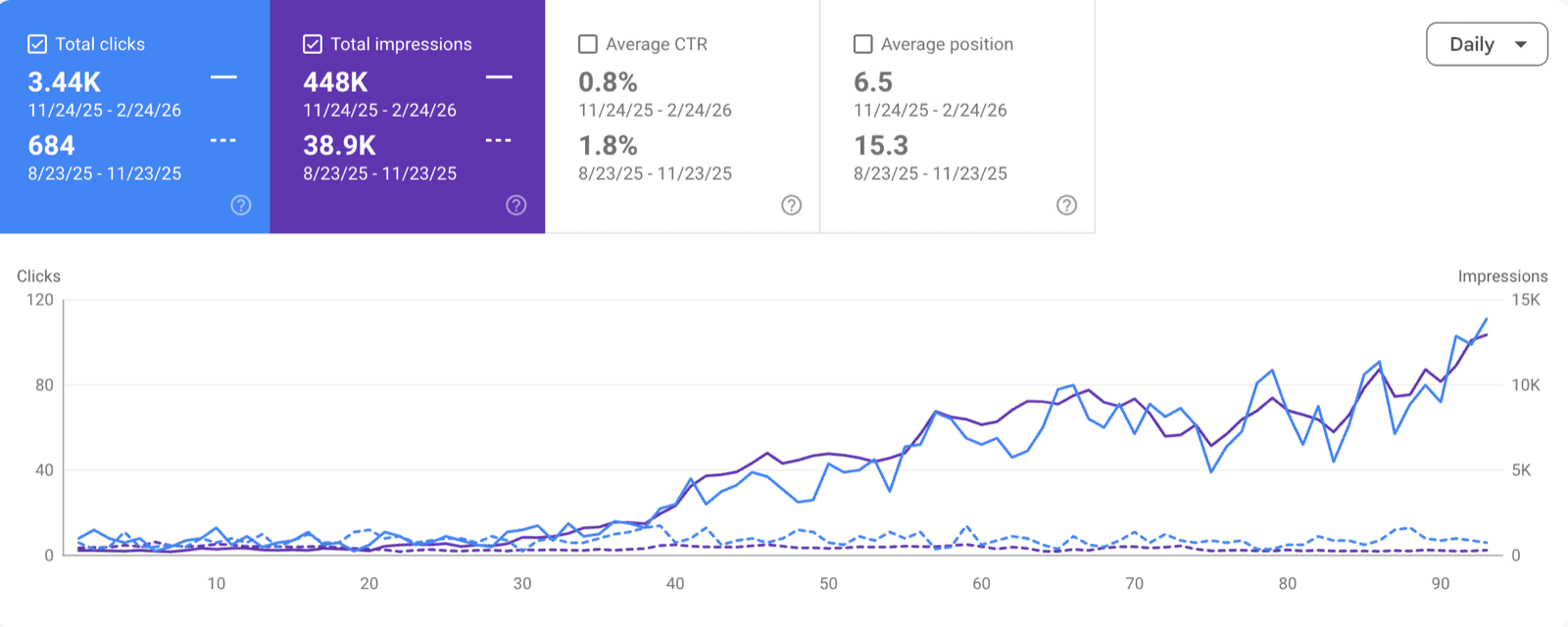
More importantly, the data shows where that growth came from.
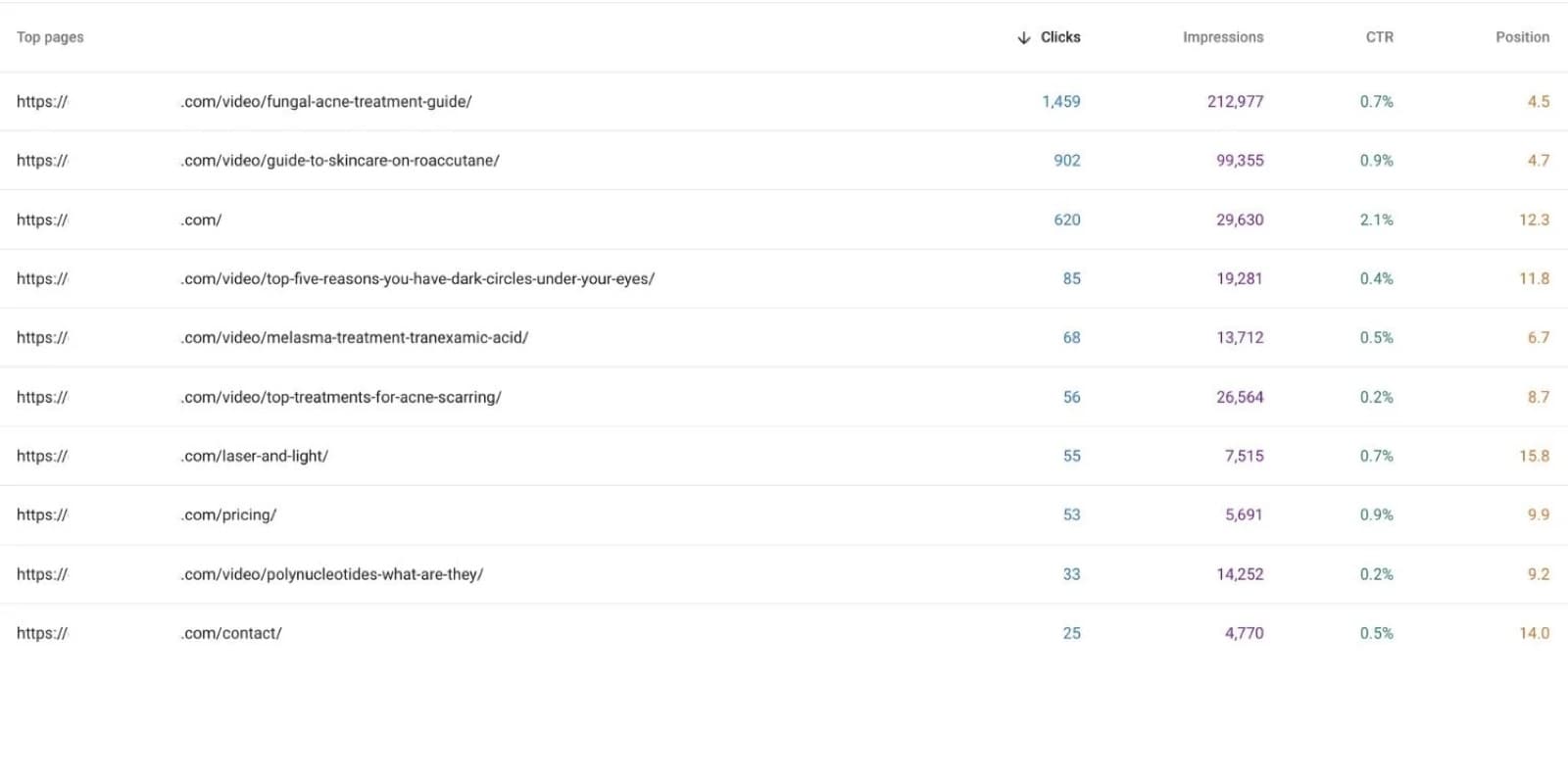
Several of the newly created content pages, built from previously underperforming videos, quickly became the top drivers of traffic, outperforming even core service and homepage URLs. One article alone generated over 1,400 clicks and 200,000+ impressions, demonstrating the scale of opportunity when content is aligned with search demand.
At the same time, average ranking position improved significantly (from ~15 to ~6), indicating stronger authority and visibility across competitive dermatology-related searches.
This wasn't driven by increased content volume. It was driven by better utilization of existing content that was strategically repurposed for AI and search.
- 6 out of the top 10 pages for traffic and clicks are new articles
- 2 of the articles are driving more traffic than the homepage
- The articles are on topics that his ideal new patients would be searching for
- All articles are averaging a position in search results of 12 or less
Over the same 90-day period, comparing performance before and after implementation further reinforces the impact of this strategy.
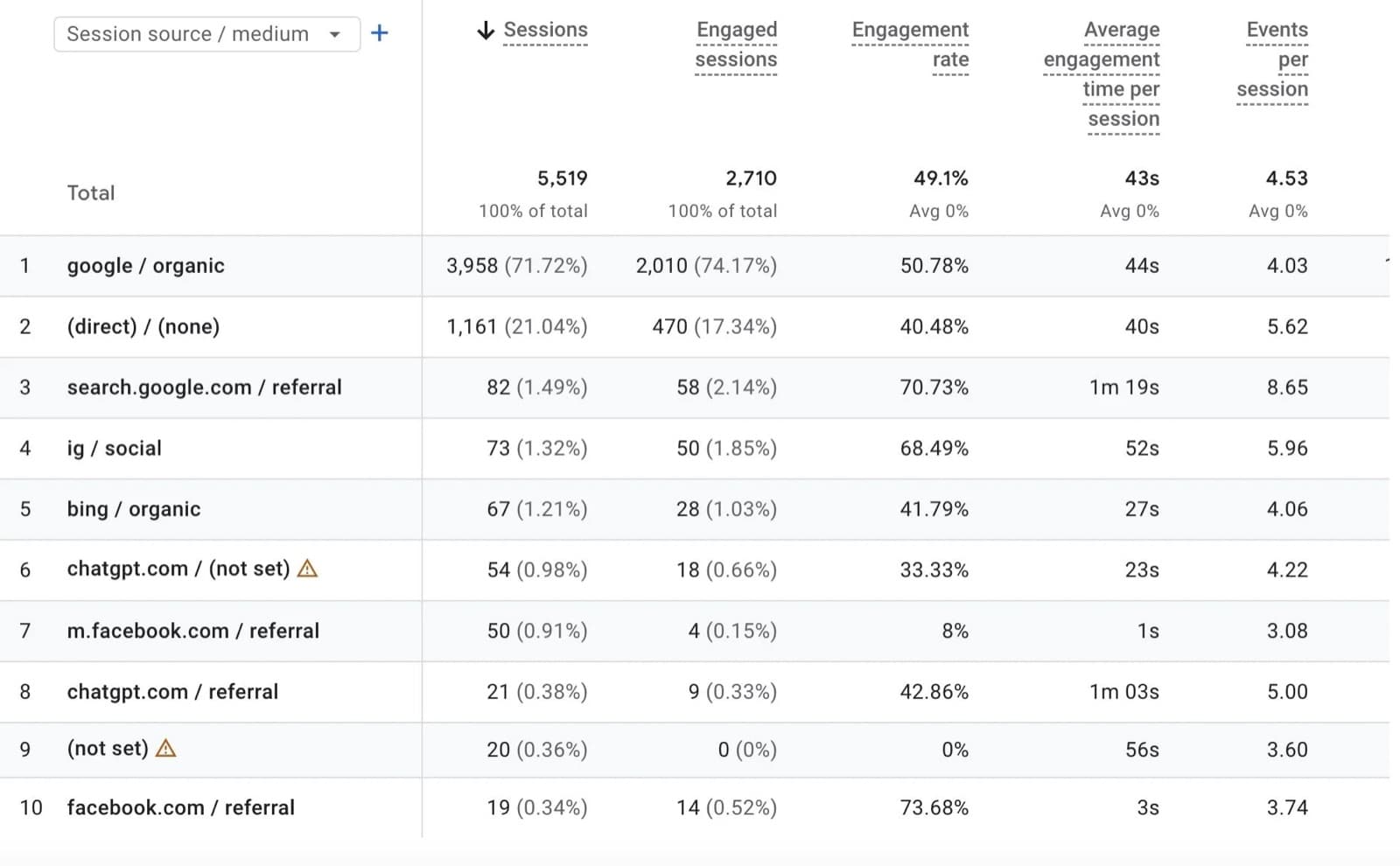
- Total sessions increased from 2,713 to 5,519 (+103%)
- Engaged sessions more than doubled, growing 149%.
- Organic search saw the most significant shift, increasing from 1,004 to 4,100 sessions (+308%) and accounting for over 74% of total traffic, compared to just 37% in the previous period.
- Engagement also improved, with average engagement time increasing by 75% overall.
- Domain Authority increased 6 points, from 25 to 31. This proves that our credibility and authority are growing through publishing content.
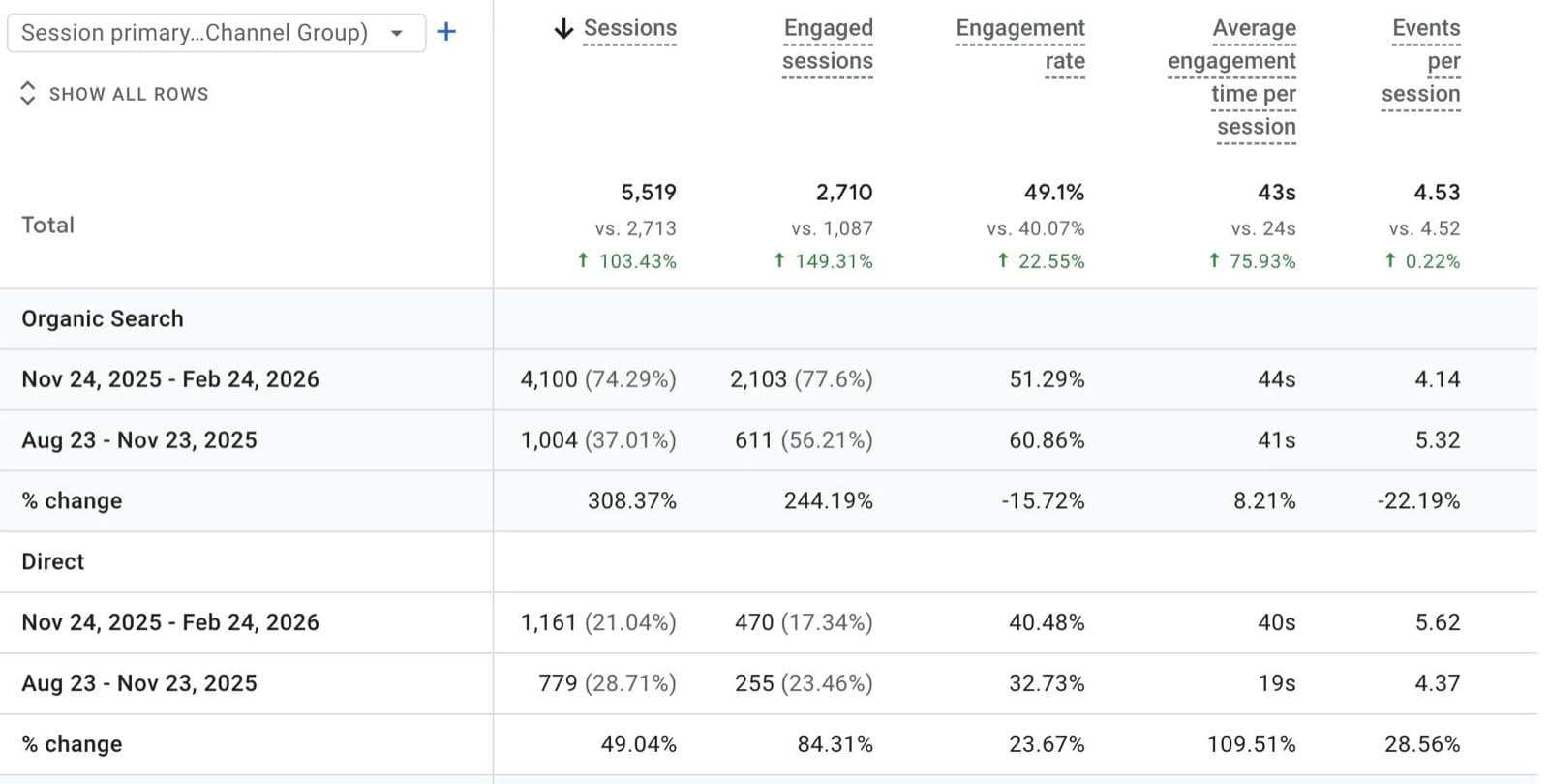
While direct traffic grew steadily, the majority of new visibility and user acquisition came from organic search. This data confirms that repurposed, search-aligned content became the primary driver of growth.
This chart is significant in showcasing the referrals from ChatGPT. In 90 days, Google Analytics shows 75 clicks from ChatGPT. This highlights a critical shift that search is no longer limited to Google.
ChatGPT is actively driving traffic, and when your content is optimized for visibility and credibility, it becomes a source AI platforms reference and recommend.
Update: Seven Months Later, It's Still Compounding
The 90-day numbers above were strong on their own. What matters more for a strategy built on repurposing, not recreating, is whether that growth holds up over time. Seven months in, it hasn't just held, it's accelerated.
+541%
Organic clicks (was +403% at 90 days)
+1,905%
Impressions (was +1,051% at 90 days)
22 → 9.8
Average position (from a prior-period baseline)
Ranking keywords grew from 16 before this engagement to 1,434 today, a 39.8x increase, and the month-over-month growth rate isn't decaying. Each new content cluster is building on the authority the last one created rather than competing with it.
AI visibility is also growing, tracked separately from the ChatGPT referral data above: 643 citations and 184 cited pages across AI platforms worldwide, up 33.1% and 36.3% respectively in the past six months. AI citation for any single practitioner is still hard to predict, which is exactly why the underlying SEO fundamentals matter regardless of what any one AI platform decides to surface.
Want to see what results your content could get?
Get My Free Content Visibility ScoreWhat This Case Study Proves
This case study highlights an important shift in how SEO works for health and wellness professionals.
For years, SEO strategies have focused on creating new content to increase keyword coverage and organic visibility. While new content remains important, one of the greatest opportunities often already exists: the educational expertise you've spent years sharing through social media, podcasts, webinars, and patient education.
When that expertise is strategically aligned with search demand and expanded into comprehensive, search-optimized resources, it becomes much more than a social media post. It becomes a long-term acquisition asset that continues attracting high-intent visitors long after the original content was published.
For our client, this strategy delivered measurable business outcomes:
- 541% increase in organic clicks within seven months
- 1,434 ranking keywords, up from just 16
- Referral traffic and citations from AI platforms, including ChatGPT
- Increased qualified patient inquiries and new bookings through organic search
Just as importantly, these results continue to compound over time.
Unlike social media content, which often reaches the majority of its audience within days, search-optimized educational resources continue building visibility as they gain rankings, strengthen topical authority, and expand the website's overall search footprint.
The fungal acne guide highlighted earlier is a perfect example. A short-form video that generated approximately 1,200 social media views became one of the website's highest-performing pages after being expanded into a comprehensive educational resource. Months later, it continues to generate organic traffic, impressions, and new patient opportunities.
The Bigger Opportunity
If you're already investing time creating educational videos, answering patient questions, speaking on podcasts, or sharing your expertise online, you're already producing valuable SEO and AI-trusted content.
The opportunity isn't necessarily creating more.
It's identifying which pieces of expertise have the greatest search potential, expanding them into comprehensive educational resources, and building a website that continues working long after a social post has disappeared.
For health and wellness professionals, that's the difference between creating content for today's algorithm and building a sustainable source of organic traffic, AI visibility, and patient acquisition.
The expertise already exists. The opportunity is making it discoverable.
What This Means for Your Business
If you're creating educational content to grow your personal brand, practice, or business, you're likely sitting on the same opportunity.
Every video you've recorded, every patient question you've answered, every podcast interview you've given, and every educational post you've shared contains valuable expertise. Yet for many health and wellness professionals, that expertise exists almost exclusively on social media, where its lifespan is measured in days rather than months or years.
As a result, much of your content is likely:
- Reaching only a fraction of your potential audience
- Missing opportunities to rank in Google and AI-powered search
- Failing to contribute to long-term website growth and topical authority
- Working hard for engagement, but not for sustained patient acquisition
A strategic SEO search and AI visibility approach changes that.
By aligning existing educational content with real search demand and expanding it into comprehensive, search-optimized resources, your content can continue attracting qualified visitors long after it's published. This creates an acquisition channel that compounds over time rather than disappearing with the next algorithm update.
The question isn't whether you need more content.
It's whether you're maximizing the value of the expertise you've already created.
Ready to Unlock More Value From Your Existing Content?
If you're already investing time creating educational videos, podcasts, webinars, or social content, but you're not seeing that effort translate into consistent website traffic, patient inquiries, or AI visibility, there's a good chance you're facing the same challenge.
We help health and wellness professionals transform existing educational content into a long-term growth strategy through:
- Comprehensive SEO & AI Visibility Audits
- Search-driven content strategy
- Technical SEO and topical authority development
- Educational content expansion and optimization
- Long-term SEO and AI visibility consulting
The result is a website that works alongside your social media, continuing to attract high-intent visitors, strengthen your online authority, and generate qualified inquiries long after your content is published.
Discover the Hidden SEO Potential in Your Existing Content
Submit three educational videos and we'll identify which ones have the greatest opportunity to drive long-term traffic, AI visibility, and patient inquiries.
You'll receive:
- Search demand analysis
- Keyword competition
- AI discoverability potential
- Content expansion recommendations
- Priority ranking opportunities
Ready to find out what your content is worth?
Analyze My 3 Video Topics