
TL;DR
If you're a health and wellness practitioner, it can feel impossible to compete with Mayo Clinic or Cleveland Clinic online. This test suggests you don't have to beat them on every question. To be recommended by AI, you first have to be understood by AI.
How did I run this test?
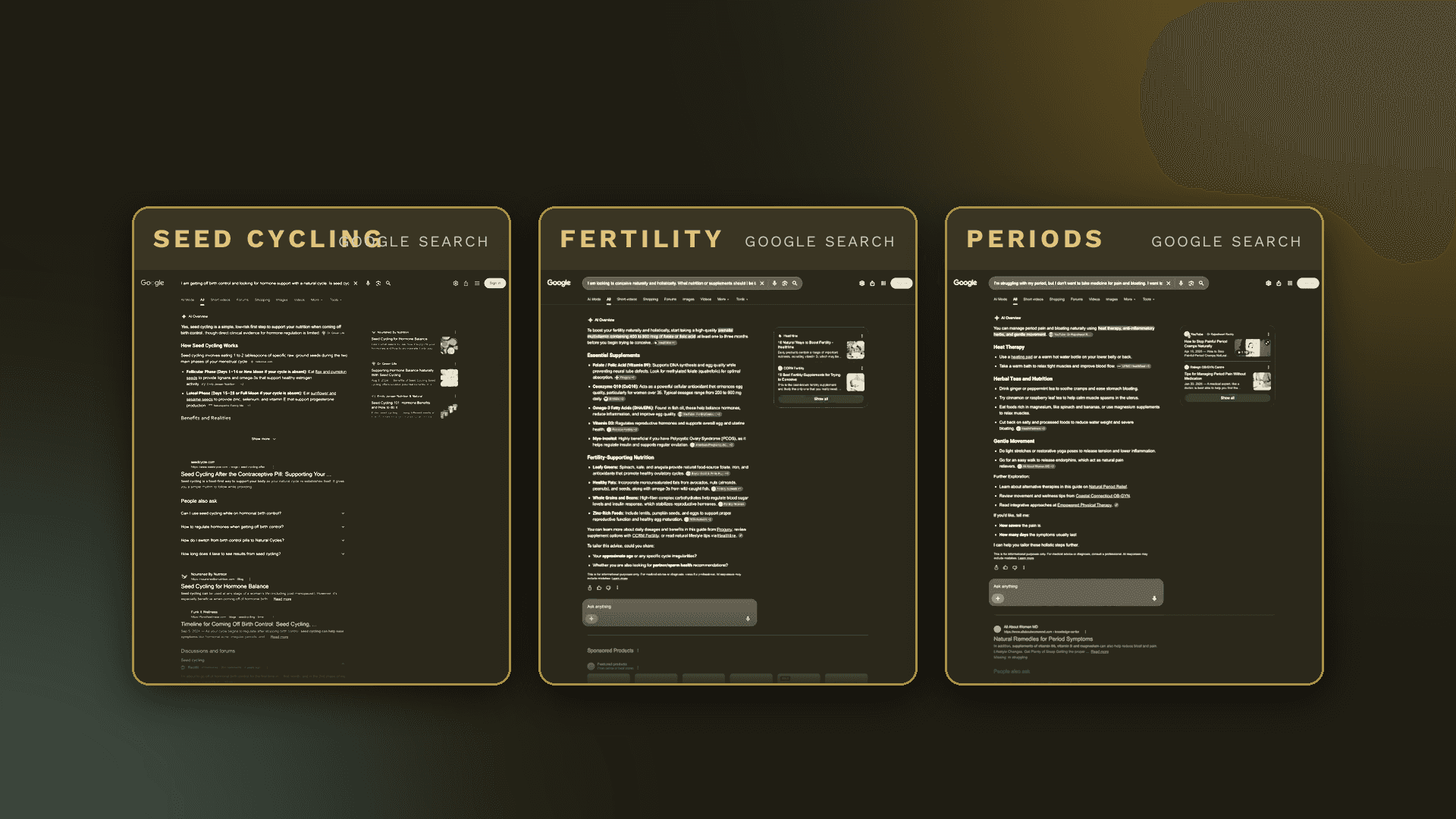
I ran three series of prompts through ChatGPT, Google AI Mode and Perplexity, and ran the opening prompt of each through a regular Google search. I asked each follow-up in the same thread, the way a real person would. All searches were done on September 22 and 23, 2026, from the Greensburg/Pittsburgh, PA area.
The test started as part of an Authority Gap Audit for a women's hormone-health creator. She has more than 413,000 Instagram followers with a digital course, community and seed cycling products, yet her website gets little organic or AI traffic. I wanted to see who AI cites, recommends and sells to when her audience asks her kinds of questions.
| Stage | Seed cycling | Fertility | Periods |
|---|---|---|---|
| 1. Information | “I am getting off birth control and looking for hormone support with a natural cycle. Is seed cycling a good first step?” | “I am looking to conceive naturally and holistically. What nutrition or supplements should I be taking for the highest chance of fertility?” | “I'm struggling with my period, but I don't want to take medicine. I want to go a holistic route. What would you recommend?” |
| Follow-up detail | “Mirena IUD, 8 years and want a natural cycle without the hormone crash” (ChatGPT asked which birth control I'd used) | None | “For pain and bloating” |
| 2. Experts | “What experts would you recommend I learn from? Are there seed cycling products you recommend?” (experts and products asked together) | “Are there practitioners in my area that specialize in this?” (on Perplexity I added “In Pittsburgh, PA”) | “Can you find me natural practitioners that are period experts?” |
| 3. Products and programs | Asked with the experts question above | “Are there any online programs for this?” | Not asked |
| Why this series | Her origin story and her product. Noticed a content gap within her posts about birth control and post-birth control recommendations. | A core content pillar for her audience and something she frequently posts content about. | A common everyday problem she posts about and the audience is seeking answers for. |
I used incognito windows to limit personalization, but location still came through. Google placed me in the Greensburg, PA area based on past activity or my IP address. On Perplexity, I added “in Pittsburgh, PA” to the practitioner question for fertility. Results change by person, location and exact wording, so treat this as a snapshot, not a ranking.
Each series follows the path a real person takes: “What should I do?” then “Who can help me?” then “What can I buy or join?” Five findings came out of it.
Explore the results
Pick a conversation and a stage to see exactly what each platform returned. The findings follow below.
Choose a conversation
Then a stage
Prompt
“I am getting off birth control and looking for hormone support with a natural cycle. Is seed cycling a good first step?”
Follow-up detail: “Mirena IUD, 8 years and want a natural cycle without the hormone crash” (ChatGPT asked which birth control I'd used).
Perplexity
10 sources, led by Natural Cycles and Healthline, plus creator sites Nourished By Nutrition, Dr. Will Cole and Dr. Jolene Brighten
Google AI Mode
News-Medical and GoodRx, plus practitioner sites: Dr. Jolene Brighten, Nourished By Nutrition, Emily Jensen Nutrition, Naturopathic Family Medicine
Google Search
Practitioner and creator sites: seedcycle.com, Nourished By Nutrition, Funk It Wellness, Dr. Jolene Brighten, The Seed Cycle, Dr. Will Cole, Emily Jensen Nutrition; Reddit; no PubMed, Mayo Clinic or Cleveland Clinic
Prompt
“What experts would you recommend I learn from? Are there seed cycling products you recommend?”
Experts and products were asked together. Google Search was only run on the opening prompt of each series.
ChatGPT
Nicole Jardim, Lara Briden ND (author of Period Repair Manual) and the Institute for Menstrual Health practitioner directory. Called Jardim “probably the closest match” and cited her seed cycling protocol.
Perplexity
A table of practitioner types (OB-GYN, reproductive endocrinologist, registered dietitian, pelvic floor PT). Small practices appeared among its 15 sources, but not in the answer itself.
Google AI Mode
Dr. Jolene Brighten (author of Beyond the Pill), Dr. Aviva Romm, MD (author of Hormone Intelligence) and Dr. Mark Hyman, MD. Each has published extensively on this exact topic.
Prompt
“Asked with the experts question above.”
Google AI Mode
Funk It Wellness, Moon Cycle Seed Company
Prompt
“I am looking to conceive naturally and holistically. What nutrition or supplements should I be taking for the highest chance of fertility?”
Google AI Mode
Fertility clinic blogs (CCRM, Progyny, Shady Grove, Kindbody), Natalie Crawford MD's YouTube
Google Search
Sponsored supplements first, then clinic blogs (Progyny, CCRM, Pacific Fertility Center), Healthline, UCLA Health, one NIH article; Reddit
Prompt
“Are there practitioners in my area that specialize in this?”
On Perplexity I added “In Pittsburgh, PA.” Location came from the Greensburg/Pittsburgh, PA area.
ChatGPT
Chelsea DeAngelis RD, Emily Timm RD, Shoshana Genack RD, SuMa Medicine, Trillium Natural Medicine, Dr. Conan Shaw, UPMC Magee, Shady Grove
Perplexity
Chelsea DeAngelis RD, Melinda Piatek RD, UPMC Magee, AHN, Pittsburgh Fertility, Advanced Women's Care
Google AI Mode
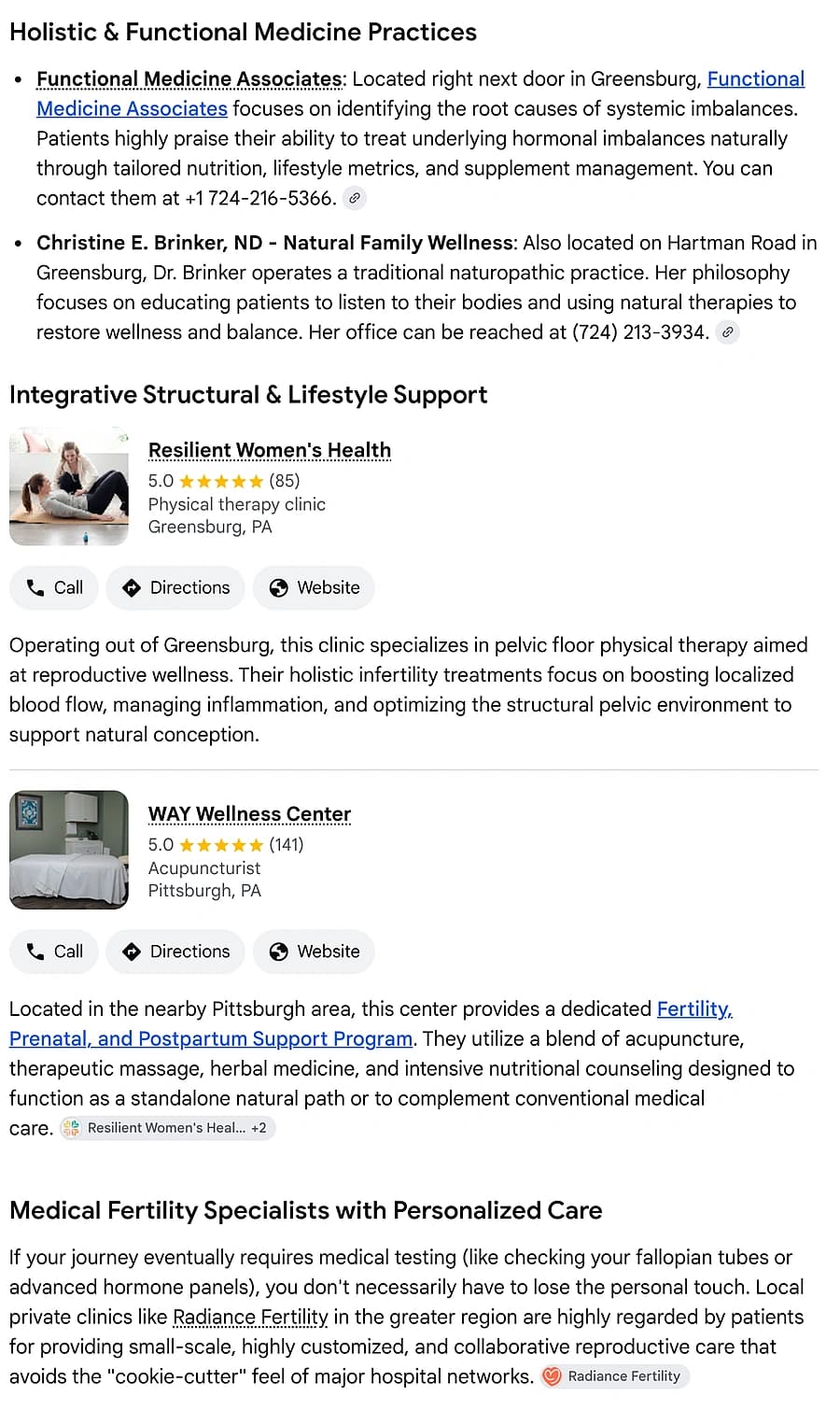
Functional Medicine Associates, Christine Brinker ND, Resilient Women's Health, WAY Wellness Center, Radiance Fertility
Prompt
“Are there any online programs for this?”
ChatGPT
Fully Fertile, Fertility Foundations, The Conception Connection, Ready. Set. Baby!
Perplexity
Pregnancy Nutritionist's $395 package, Chelsea DeAngelis RD by telehealth, ASRM's free fact sheet
Google AI Mode
Parsley Health, Flora Naturopathics, Natalie Crawford MD's Enhance Your Natural Fertility, Built To Birth, Holistic Fertility Collective, Aphrodite Fertility
Prompt
“I'm struggling with my period, but I don't want to take medicine. I want to go a holistic route. What would you recommend?”
Follow-up detail: “For pain and bloating.”
Google AI Mode
UPMC HealthBeat, OB-GYN practice blogs (Thrive Wellness Center for Women, Lyndhurst Gynecologic Associates, All About Women MD), The Nutrition Institute, Dr. Eric Berg's YouTube
Google Search
Practice blogs: All About Women MD (#1), CT Coastal OBGYN, UPMC HealthBeat, HealthPartners, Covington Women's Health Specialists; Healthline; Reddit and Facebook groups
Prompt
“Can you find me natural practitioners that are period experts?”
ChatGPT
Trillium Natural Medicine, New Moon Acupuncture, markacupuncture, Natural Way Clinic, Nourish and Move, Divekar & Associates, UPMC Center for Integrative Medicine
Perplexity
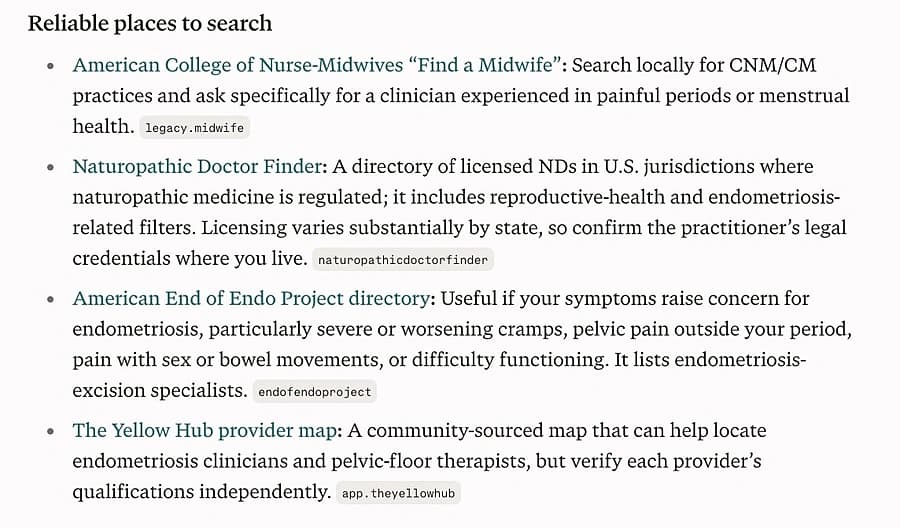
No names; asked for a ZIP code and listed directories (ACNM Find a Midwife, Naturopathic Doctor Finder, End of Endo Project)
Google AI Mode
Resilient Women's Health, Functional Medicine Associates, Integrative Health & Wellness Center, Embody Wellness, Wild Goddess, Bartlett Acupuncture; virtual: Aviva Romm MD, Allison Jung
Finding 1: Do broad health questions favor big institutions?
Often, yes, but the results tell a platform-specific story. In these tests, ChatGPT and Perplexity leaned heavier on published research and medical sources such as PubMed, the NHS, ASRM and ACOG for broad “what should I do?” questions, while Google AI Mode and Google Search mixed in more practitioner blogs and credentialed creators who had written about the questions asked. Smaller experts became much more visible as the questions got specific to locality and buying decisions.
- On Google, the page that answered the exact question got cited. Local OB-GYN practices such as CT Coastal OBGYN and Raleigh OB/GYN Centre were cited for period pain because they had published articles on it.
- The platforms disagreed on the advice. Google AI Mode suggested CoQ10 and myo-inositol for fertility, and magnesium, vitex and dandelion root for periods. ChatGPT and Perplexity said the evidence for most of these is limited. Whatever your pages say may be repeated to patients, so accuracy matters.
Human expertise still matters here. Pew Research Center's April 2026 report, Where Do Americans Get Health Information, and What Do They Trust?, looked at where Americans actually go for health information.
85%
get health information from providers at least sometimes
22%
get health information from AI chatbots
Most chatbot users rate that information as only “somewhat” accurate. People use AI to find answers faster, but they still want those answers to lead back to a trusted expert.
Finding 2: Does ranking in regular Google search still matter for AI?
On Google, it matters a lot. In this test, the practice and creator pages that ranked on page one of Google Search were largely the same pages cited in Google's AI Overviews and AI Mode. Organic SEO and AI visibility weren't separate races on Google. They drew from the same pool of pages.
| Site | Google Search, page one | Google AI Overview | Google AI Mode |
|---|---|---|---|
| All About Women MD | #1 in both period searches | Cited in the pain and bloating search | Cited for pain and bloating |
| CT Coastal OBGYN | Page one in both period searches | Cited, and linked under “Further exploration” | Cited for heat therapy |
| UPMC HealthBeat | Page one in both period searches | Cited in both | Cited |
| Dr. Jolene Brighten | Page one in both seed cycling searches | Cited | Cited, and named as an expert to follow |
| Nourished By Nutrition | Page one in both seed cycling searches | Featured in the sidebar | Featured in the sidebar |
| Emily Jensen Nutrition & Natural Medicine | Page one for seed cycling | Cited, and featured in the sidebar | Cited |
| CCRM Fertility | Page one in both fertility searches | Cited | Cited |
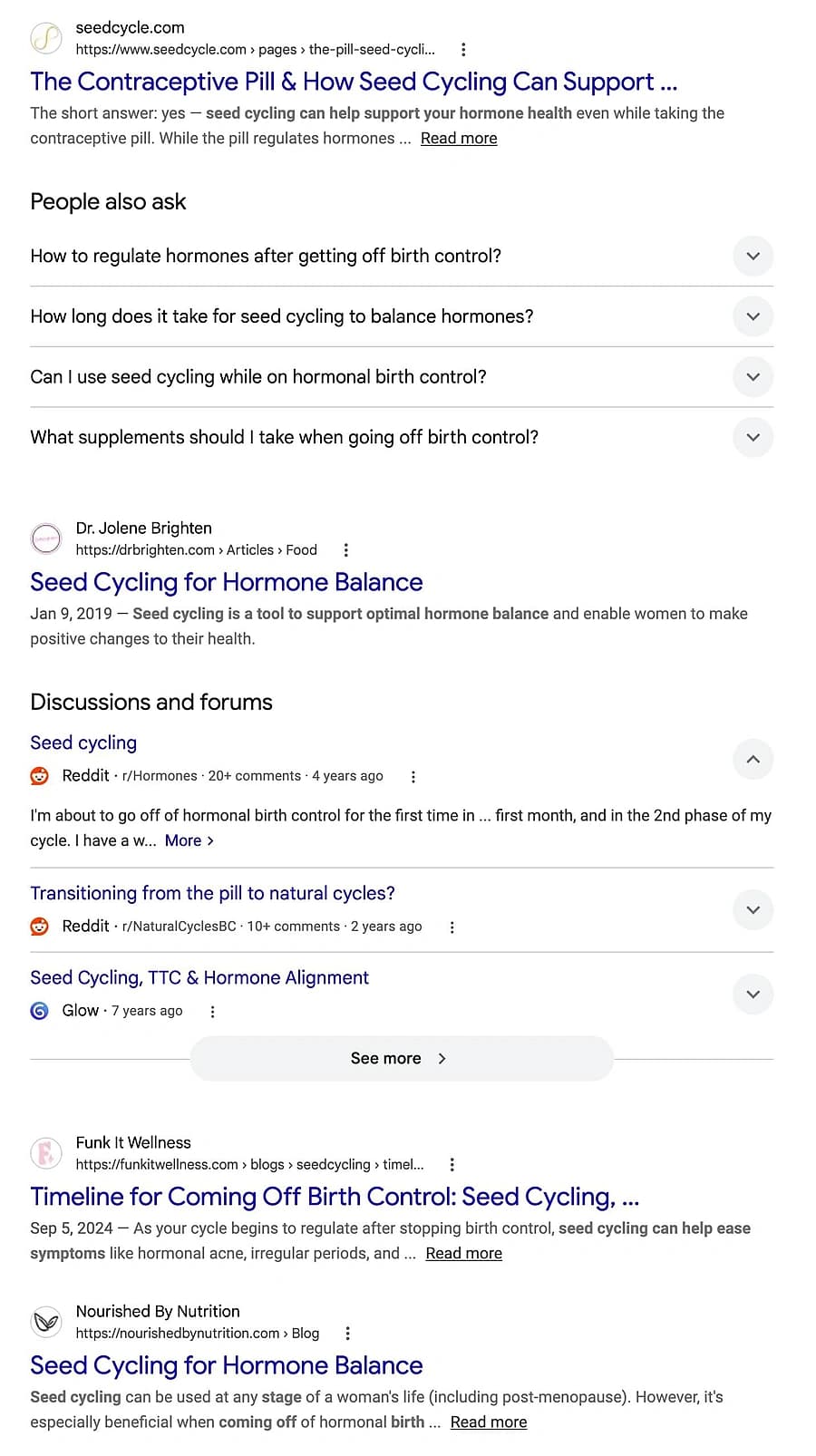
What else the organic results showed:
- Page one belonged to practices and creators, not institutions. For seed cycling, it was seedcycle.com, Nourished By Nutrition, Funk It Wellness, Dr. Jolene Brighten, The Seed Cycle, Natural Womanhood, Dr. Will Cole and Emily Jensen Nutrition. For periods, it was All About Women MD, CT Coastal OBGYN, HealthPartners, UPMC HealthBeat, Covington Women's Health Specialists and a Colorado pharmacy blog. Fertility was the most mixed, with Progyny, CCRM, Healthline, UCLA Health and one NIH article.
- The AI Overview sent readers straight to small practices. In the pain and bloating search, it listed “Further exploration” links to a Natural Period Relief guide, Coastal Connecticut OB-GYN and Empowered Physical Therapy.
- Forums showed up on every page. Reddit appeared for all three topics, and Facebook groups appeared for pain and bloating. “People also ask” boxes listed questions such as “What are some holistic remedies for period cramps?” All of these are ready-made content ideas, and forums are a great place to source new video and article ideas.
- Few top pages used the searcher's language. Google marked many page-one results as “Missing: holistically” or “Missing: route.” When Google AI gave me results, it searched for three separate groups of “holistic” care, such as acupuncturists, naturopaths, nutritionists and massage/PT. For holistic practitioners, that's an opening: few pages speak the way patients actually search.
- Brands paid for the top shelf. Both fertility searches showed a row of sponsored supplements (Needed, Perelel, Thorne and others) directly under the AI Overview. Beeya Wellness ran ads on both seed cycling searches.
- Rankings shifted between searches. A second fertility search surfaced several different page-one results, including the American Pregnancy Association, RMA Network and Baylor Scott & White.
For practitioners, the takeaway is practical. On Google, the work that earns a page-one ranking is largely the same work that gets you cited in AI answers.
Why I think Google will stay central
Google's AI results will remain a leading place people search, simply because people are already in the habit of using Google. What's changing is how they ask.
AI search is scaling fast across every major platform, and it's happening on top of Google's existing search volume, not instead of it:
1B+
Google AI Mode monthly users
2.5B+
Google AI Overviews monthly users
900M+
ChatGPT weekly users
1B+
Gemini app monthly users
Being found in Google's AI results and being found in ChatGPT aren't competing goals. Both are growing fast, and the content that earns a page-one Google ranking is largely the same content that gets cited across all of them — which is the case for treating every article as an investment that keeps paying off, not a one-platform bet.
As people get used to AI, their searches are getting longer and more specific. Instead of typing “seed cycling,” they ask, “I'm getting off birth control and looking for hormone support with a natural cycle. Is seed cycling a good first step?” That's a real shift from how people have searched since the early days of the internet, and it rewards content that answers specific, real-life questions.
Finding 3: Do specific questions give smaller experts a chance?
Yes. Once the question became “who should I learn from?”, ChatGPT and Google AI Mode named individual practitioners and creators, often linking straight to their websites and articles. Institutions mostly dropped out.
Perplexity stayed conservative and described types of practitioners instead of naming people.
- ChatGPT recommended Nicole Jardim, Lara Briden ND (author of Period Repair Manual) and the Institute for Menstrual Health practitioner directory. It called Jardim “probably the closest match” and cited her seed cycling protocol.
- Google AI Mode named Dr. Jolene Brighten (author of Beyond the Pill), Dr. Aviva Romm, MD (author of Hormone Intelligence) and Dr. Mark Hyman, MD. Each has published extensively on this exact topic.
- Perplexity gave a table of practitioner types (OB-GYN, reproductive endocrinologist, registered dietitian, pelvic floor PT). Small practices appeared among its 15 sources, but not in the answer itself.
Finding 4: Do local recommendations reward clarity?
In this test, they did. When I asked for practitioners near me, the ones who came up weren't the biggest names. They were practices whose websites, Google Business Profiles and directory listings made it easy to tell what they treat, how and where. You can see every name each platform returned for fertility and periods in the explorer above.
The strongest signal: some practitioners showed up more than once. Resilient Women's Health and Functional Medicine Associates appeared on Google for both fertility and periods. Trillium Natural Medicine appeared on ChatGPT for both. Chelsea DeAngelis appeared on both ChatGPT and Perplexity. Showing up for one keyword is useful, but being picked for several related women's health needs suggests AI understands the practice's broader area of expertise.
AI connected two areas of expertise to one problem. ChatGPT explained that it recommended New Moon Acupuncture because the practice's published areas of focus include both pelvic pain and digestive/bowel irregularities. My question combined period pain and bloating. AI wasn't just matching “period expert” to a keyword. It had enough context about the practice to connect several pieces of its expertise to the problem I described. That's what a strong content ecosystem does: it gives AI more context for when your expertise is relevant.
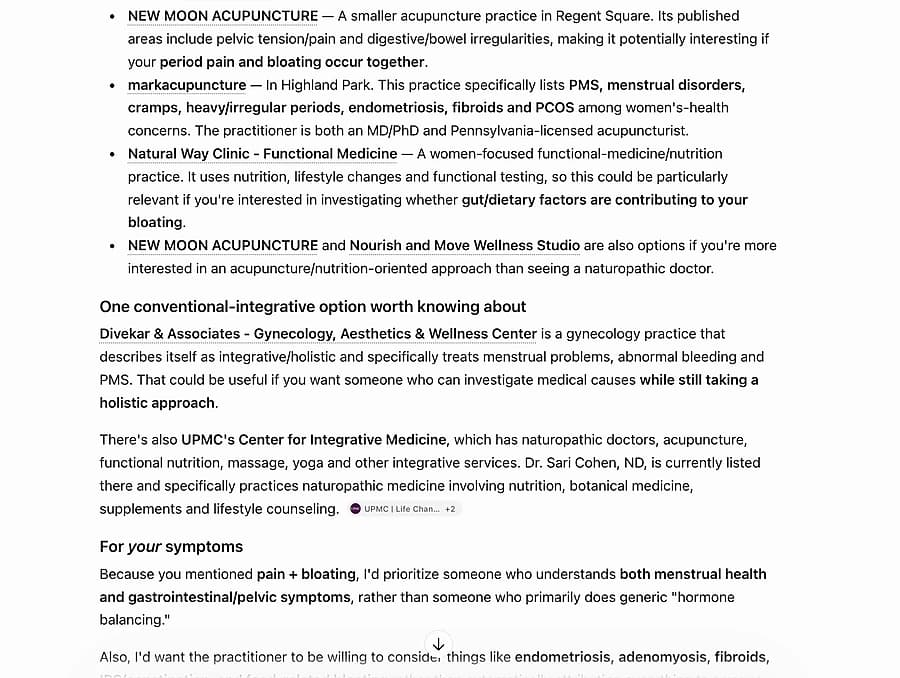
Another pattern when it comes to asking for practitioners:
- AI leans on third-party directories to recommend credentialed professionals within the health and wellness industry. This continues the conversation around adding third-party websites and directories to your marketing strategy.
Why do online services give local practices a bigger payoff from AI?
A local practice can only turn an AI recommendation into a patient if that person lives nearby. For broad questions, ChatGPT and Perplexity cited research institutions, not local practices. When Google did cite local practices, such as CT Coastal OBGYN and Raleigh OB/GYN Centre for period pain, the searcher was in Pennsylvania. That's great visibility, but it's hard to turn into a patient visit.
Offering online services or courses removes that ceiling. In this test, ChatGPT sent a Pennsylvania user to two Australian programs, The Conception Connection and Monash IVF's Ready. Set. Baby!.
An online offer lets you benefit when AI recommends you to everyone else. Clinical telehealth often depends on where you're licensed, but courses, group programs and educational products can usually serve anyone.
For a local practice, that could look like:
- A telehealth or virtual consultation page that says which states you serve
- A self-paced course or group program with its own landing page
- Digital products tied to your specialty, such as guides, meal plans or kits
Finding 5: Do products and programs need their own searchable identity?
In this test, the products and programs that got recommended had their own clearly described pages: a name, who it's for, what's included and a price. The strongest position belonged to experts who showed up at every stage: cited for information, named as an expert, then recommended for their product. Open the “Products & programs” stage in the explorer above to see what each platform recommended.
- Expert and product reinforced each other. Google cited Natalie Crawford MD's YouTube videos for fertility nutrition, then recommended her paid program.
- Clear pages traveled far. ChatGPT recommended two Australian programs, The Conception Connection and Monash IVF's Ready. Set. Baby!, to a user in Pennsylvania.
- Brands also paid for visibility. On Google's organic fertility page, six sponsored supplement products sat directly below the AI Overview. Beeya Wellness and Natural Cycles ran ads on the seed cycling page. There was also a Beeya ad on ChatGPT that appeared with the seed cycling prompt.
AI recommendations aren't always internally consistent. ChatGPT recommended Fertility Foundations even though one of its modules is called “Pre-Pregnancy Detox,” while cautioning against detox programs in the same response. Being recommended by AI shouldn't be read as an endorsement of every claim on the page.
The pattern: What does AI need to understand before it recommends you?
AI recommendations appear to be built around relationships, not just rankings. The practitioners who surfaced weren't necessarily the biggest brands or the creators with the most social media followers. What they had was enough searchable evidence for AI to connect them to the question being asked.
| What AI has to connect | Example from this test |
|---|---|
| Who you are | ChatGPT and Perplexity both repeated Chelsea DeAngelis's credentials (“MPH, RD, LDN”) and her Pittsburgh location |
| What you're qualified to talk about | Dr. Jolene Brighten's book and seed cycling guides |
| Which problems you address | New Moon Acupuncture's pelvic pain and digestive focus matched a question about period pain and bloating |
| How you help | Trillium Natural Medicine spells out naturopathy, acupuncture, Chinese medicine and nutrition |
| What you offer | Trillium's Natural Fertility Program page and fertility intake form; Fertility Foundations' module list and price |
| Where you're available | Resilient Women's Health lists a Greensburg address, its Pittsburgh and Westmoreland service area, and virtual visits statewide |
| Who else confirms it | DeAngelis's HealthProfs listing, Melinda Piatek's Full Well Fertility directory profile, Google Business Profile reviews |
How did each platform behave in this experiment?
In this experiment, Google AI Mode surfaced the widest variety of smaller experts. Perplexity was the most conservative about recommending practitioners directly. ChatGPT landed somewhere in between.
| Platform behavior | Google AI Mode | ChatGPT | Perplexity | Google organic |
|---|---|---|---|---|
| Information sources | Practice blogs, creators, YouTube, health publishers | PubMed, NHS, CDC, ASRM, ACOG | Guidelines, journals, a few large publishers | AI Overview, then ads, practice blogs and Reddit |
| Experts named | Many; hyperlocal; all types of holistic care | Many; dietitians and integrative practices | Few; credentialed only, or directories | Named in the AI Overview |
| Products and programs | Niche brands and courses | Retailers and course pages | Rarely; licensed care preferred | Sponsored products and brand pages |
| Signals that appeared in this test | Content matching the exact question, Business Profiles, reviews and local signals | Specialty and service pages, supporting content, map and web listings | Credentials, evidence-based content, directories | Traditional SEO |
Keep in mind that this is a very small experiment, with many variables that will change based on a person's location, chat history and the questions asked.
I found it interesting to compare the platforms to see what information is being considered and who it specifically recommends.
Is SEO the same as AI visibility?
No, but there is overlap. Across the recommendations I reviewed, the sites tended to be crawlable, clearly structured and explicit about their expertise, services or products. SEO lays much of that groundwork. In this test, experts with well-developed, search-friendly libraries of expertise repeatedly appeared across both organic and AI results.
AI visibility adds a harder test: can the platform confidently connect who you are, what you know, what you offer, who it's for, where you serve and who else vouches for you? That decides whether you're cited as a source or named as the recommendation.
The platforms didn't recommend the same people. They didn't cite the same sources. They didn't even always give the same advice.
But the experts who surfaced gave the web enough information to connect who they are, what they know, the problems they address, how they help, what they offer and where they're available.
Your goal isn't to optimize for one AI platform. It's to build enough searchable evidence that any discovery system can understand what you're an authority on.
What should health and wellness experts do to get recommended by AI?
Make it easy for AI to understand who you are, what you know, who you help and what you offer. This test points to six specific moves:
- Create a page for every real specialty. Not “Women's Wellness.” Fertility nutrition, PCOS, painful periods, perimenopause: whatever you genuinely specialize in.
- Publish around symptoms as well as conditions. People don't always search “endometriosis.” They ask, “Why am I bloated and in pain before my period?”
- Connect related expertise with internal links. Fertility, PCOS, progesterone, cycle health and nutrition should link to each other so AI sees one connected body of work. New Moon Acupuncture shows why: its pelvic pain and digestive expertise together matched a single question.
- Make your credentials, location and modalities unmistakable. AI shouldn't have to hunt for RD, LAc, MD or ND, for Pittsburgh or telehealth, or for acupuncture or nutrition.
- Build confirmation outside your website. Google Business Profile, professional directories, podcasts, interviews, relevant publications, reviews and associations.
- Give every program and product a real landing page. Include who it's for, what it does, who created it, their credentials, the format, price, FAQs and related educational content.
That's the difference between posting content and building an Authority Asset ecosystem. For more tactics to win in AI search, read: How to Get Noticed by AI: 12 Easy Wins for Health & Wellness Experts.
Proof that sharing your expertise works
This isn't just theory. We've already seen what happens when expert content is given a more discoverable home.
For a Mudra client — a London consultant dermatologist — we used his existing expertise as the foundation for search-focused authority assets. He's a sole practitioner, not a large practice with a marketing team, and even he is winning. Within 90 days:
+403%
organic clicks
+1,051%
search impressions
11 months
and results are still compounding
ChatGPT began referring visitors directly to the website within that first 90 days. Today, almost 11 months in, 9 of the site's 10 highest-performing pages are his articles, and 21 of them are now being cited as a source across AI platforms.
Those are that client's individual results, not a prediction of what any other practice would achieve. But they demonstrate the principle behind everything in this article: sharing your expertise on social media builds trust, but turning it into owned, searchable content is what lets Google and AI platforms actually find and cite it.
What did this mean for the creator I audited?
Her gap wasn't audience. It was searchable authority. She has more than 413,000 Instagram followers and products, but her website has very little product content for AI to recommend. A scan of her Instagram feed also found no posts on post-birth control nutrition, even though that's her origin story and there's real search volume around this topic. Her expertise lives on social media, where AI can't easily connect it to the questions her audience asks.
What she needs is a library of authority assets — owned content built to answer the exact questions her audience is already asking on Google and AI platforms, not just on Instagram.
Winning on social, but not online?
The CAVA Method is Mudra Marketing Group's done-for-you service that turns your best short-form videos into long-form articles and an asset library built to be found on Google and cited by AI.
Learn about the CAVA MethodFAQs
Can a small health practice show up in AI search?
Yes. In this test, Google AI Mode and ChatGPT named small local practices, solo dietitians and creators alongside large institutions. What they had in common was clear, searchable information about their specialty, services and location, not their size.
Do I need a big social following to get recommended by AI?
No. Nicole Jardim has about a third of the Instagram audience of the creator I audited, and ChatGPT still recommended her first for seed cycling after birth control. Social reach and searchable authority are not the same thing.
Which AI platform was hardest for holistic practitioners?
In this experiment, Perplexity. It named only credentialed practitioners such as registered dietitians and medical clinics, and pointed users to licensing directories. Clear credentials and evidence-based language may help there.
Is SEO still worth doing if people use AI?
Yes. The recommended sites I reviewed tended to be crawlable, clearly structured and specific, which is what SEO builds. AI visibility adds a second test: whether AI can connect who you are to the question being asked.
Why did each AI give different answers to the same question?
Each platform pulls from different sources and applies different thinking depending on the question. Answers can also change between runs. There is no end-all-be-all when it comes to AI search.
Want to know where you stand?
An Authority Gap Audit shows where AI already cites you, where it recommends someone else, and which content would close the gap.
Sources
- Pew Research Center, Where Do Americans Get Health Information, and What Do They Trust? (April 7, 2026)
- TechCrunch, Google's Gemini app surges to one billion users (August 11, 2026) — Google AI Mode and Gemini app monthly user figures
- CNBC, Google CEO Pichai: AI Overviews now has over 2.5 billion monthly users (May 19, 2026)
- Search Engine Land, OpenAI: ChatGPT now has 900 million weekly active users (February 2026)
Note: Google AI Mode links expire after 7 days.
Last updated September 25, 2026