
A Search & AI Visibility Audit of a Women's Nutrition and Hormone Health Brand
This is Volume 01 of the Authority Gap series, where I audit a popular health and wellness creator or brand from a search and AI visibility standpoint. First up: what one wellness brand's massive social following reveals about the gap between social authority and discoverable authority, and the opportunity hiding inside years of content.
TL;DR
This one hurts my heart as a marketer.
This creator has dedicated years to consistently producing high-quality educational content around food-first hormone health, fertility and cycle education. She has the credentials, the passion, an audience of more than 413K followers on Instagram, and a product ecosystem that includes a course, a seed cycling product line, digital downloads and a paid community on Skool.
She's already done the hard part, but almost all of her hard work and expertise lives on Instagram — a rented platform that requires creators to consistently pump out content to stay relevant and in the algorithm.
Her website currently ranks for approximately 20 keywords and receives an estimated six organic visits per month.
That's a massive disconnect for someone with an audience of this size, and it's what I call the Authority Gap.
Instagram is incredibly valuable for building an audience and earning trust, but people who don't follow you are searching Google and asking AI many of the same questions you're already answering on social.
The opportunity isn't necessarily to create more content, but it's to take the best of what already exists and turn it into owned, discoverable authority assets that can keep working long after the original post disappears from the feed.
She doesn't have a content problem. She has a discoverability problem.
The Setup
- The brand
- A creator-led women's hormone and fertility wellness company
- The audience
- 413K+ Instagram followers, ~2,700 average likes and 77 average comments per post — real engagement, not bot noise (as of Sept 21, 2026). As of September 28, 2026, she has an estimated 415K followers. Due to the timing of the audit, we will reference her 413K follower count.
- The content library
- Roughly 2,000 Instagram posts
- The business
- A course, a seed cycling product line, and a paid community on Skool
- The audit
- A Semrush domain-level SEO analysis, a 92-page website crawl, backlink analysis, search-demand research, and a sample of 36 recent Instagram posts, all pulled August 2026.
And I went into the audit wanting to answer one question:
Unfortunately, the answer didn't surprise me, because I see this time after time with my clients, but it might surprise you.
How discoverable is a creator with 400K+ followers beyond Instagram?
On Google, almost not at all.
The entire website currently ranks for approximately 20 keywords and receives an estimated six organic visits per month.
Of those 20 rankings:
- 2 appear in Google's top 10
- 4 sit between positions 11–20
- 1 sits between positions 21–30
- 6 sit between positions 31–40
- 3 sit between positions 41–50
- 4 rank beyond position 50
The issue isn't that the website has a small keyword footprint, but eighteen of the twenty rankings it does have are too far down the search results to generate meaningful traffic.
Now compare that with the social side of the business:
400,000+
Instagram followers
~2,000
Instagram posts
20
ranking keywords
~6
estimated monthly organic visits
That's the Authority Gap I'm talking about. It illustrates something I think a lot of creators and practitioners miss:
Being known isn't the same thing as being findable. You can be widely known on Instagram, but not on Google, ChatGPT or Claude.
You can have hundreds of thousands of people consuming your expertise on social media while remaining virtually invisible to the person who has never heard of you, but is actively looking for the exact information, solution or product you provide.
Increasingly, that discovery isn't happening only through a traditional list of Google results.
People are asking ChatGPT, Perplexity, Google's AI-powered search experiences and other AI tools to research problems, compare options and recommend products.
Semrush analyzed more than 1 billion lines of U.S. clickstream data and found that outbound referral traffic from ChatGPT to the rest of the web grew 206% between January 2025 and January 2026.
That creates an entirely different discovery journey.
Someone could simply ask any of these platforms:
Questions people ask AI
"What should I eat during my luteal phase?"
"What foods support progesterone?"
"What should I eat while trying to conceive?"
Or even:
“What are some food-based products designed around cycle syncing?”
And for this creator, the question is twofold: Can she rank within Google and AI searches, but also are her products she's spent years building being recommended on those platforms?
That's why I see this as much more than an SEO opportunity — it's a discoverability opportunity.
People are searching. Smaller brands are capturing the demand.
The lack of organic traffic isn't because nobody is searching for what she teaches.
Approximately 65% of the keywords her website already ranks for have informational intent. The site appears for searches related to topics she regularly teaches, including “how to decrease prostaglandins,” with approximately 260 searches per month, and a natural-family-planning pricing question with approximately 320.
Those rankings aren't high enough to drive meaningful traffic yet, but they show that Google is already beginning to connect the website with the questions surrounding her expertise.
Two smaller brands in the same general niche currently rank for 86 and 114 keywords respectively — roughly four to six times this brand's entire search footprint — despite having nowhere near her 413K+ Instagram following.
She has the larger audience. She has the credentials. She has the products. She has years of educational content.
But smaller brands are capturing more of the search demand around the topics she already teaches.
That's the gap.
Social authority doesn't automatically become discoverable authority. You have to build the bridge between them.
So where did 2,000 pieces of content go?
Her 2,000 pieces of content have gone to die in her social media feeds:
- Instagram at 400K followers
- TikTok at 48.3K Followers
- YouTube at 1.6k Subscribers
Her website does include recipes, educational posts, products, guides and other resources, but when we crawled the site, we found only 18 actual blog posts.
Years of expertise have accumulated on Instagram.
That's not a criticism of the social strategy. Instagram did exactly what it was supposed to do: it built an audience.
But social platforms and an owned website play different roles in a content ecosystem. The missed opportunity is that so few of the strongest ideas have made the jump from social content into permanent, searchable resources on a platform the brand owns.
And that's where the economics of content start to change.
A Reel may create attention when it's published and continue circulating afterward, but a substantive authority asset can potentially answer the same question again and again whenever someone goes looking for it — whether that's next week, next month or next year. It can earn links. It can rank for multiple related searches. It can lead someone into another article. It can introduce a product. It can grow an email list.
The idea stops being just a post and starts becoming an asset.
What about the content she already has on her website?
This is where the gap becomes even clearer.
The website already has 18 published blog posts, but simply having a blog doesn't mean you're building authority in Google or in AI search.
Our audit found that the existing posts average approximately 546 words, with many of the recipe articles running between just 249 and 461 words. Only four of the 18 posts exceed 800 words.
The problem isn't the word count itself. It's what those pages are actually doing with those words.
Many are thin, lightly developed pieces that don't fully explore the questions someone researching these subjects would have. They lack the depth, supporting evidence, related questions and intentional connections to other relevant content that could turn a basic blog post into a genuine authority asset.
That's an SEO problem. But increasingly, it's an AI visibility problem too.
An Experiment: Asking ChatGPT, Perplexity and Google about her expertise
This is where I found one of the most interesting gaps in the audit.
Her course explicitly says it's designed for women who are trying to conceive, coming off birth control, trying to regulate their cycle or get their period back naturally, navigating PCOS, endometriosis or PMDD, and learning how to use nutrition and cycle syncing to better support their hormones.
In other words, these are problems she already teaches about and gets paid to help solve, with reviews from customers.
Very little of that expertise is supported by substantive, discoverable content on her website. Turns out, this is also the exact problem that led her to creating this business.
I used a real question that's directly in this creator's wheelhouse and happens to be a content gap I identified:
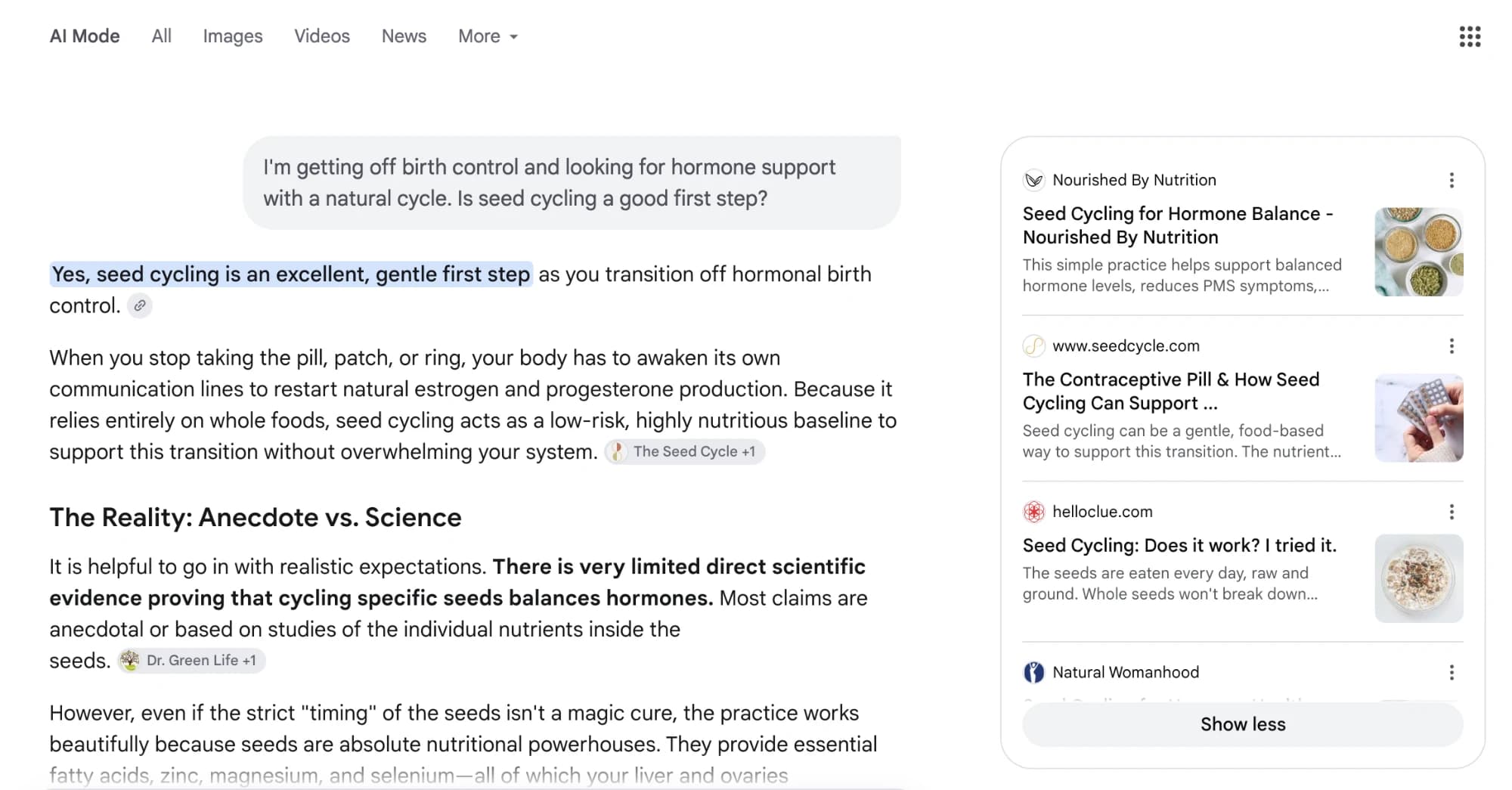
“I'm getting off birth control and looking for hormone support with a natural cycle. Is seed cycling a good first step?”
I continued the conversation in ChatGPT, asking for practitioners, products and resources, and then tested the same prompt in Google, Google AI Mode and Perplexity.
To my surprise, all the AI platforms delivered results with big medical institutions, research outlets, and links directly to credible practitioner websites.
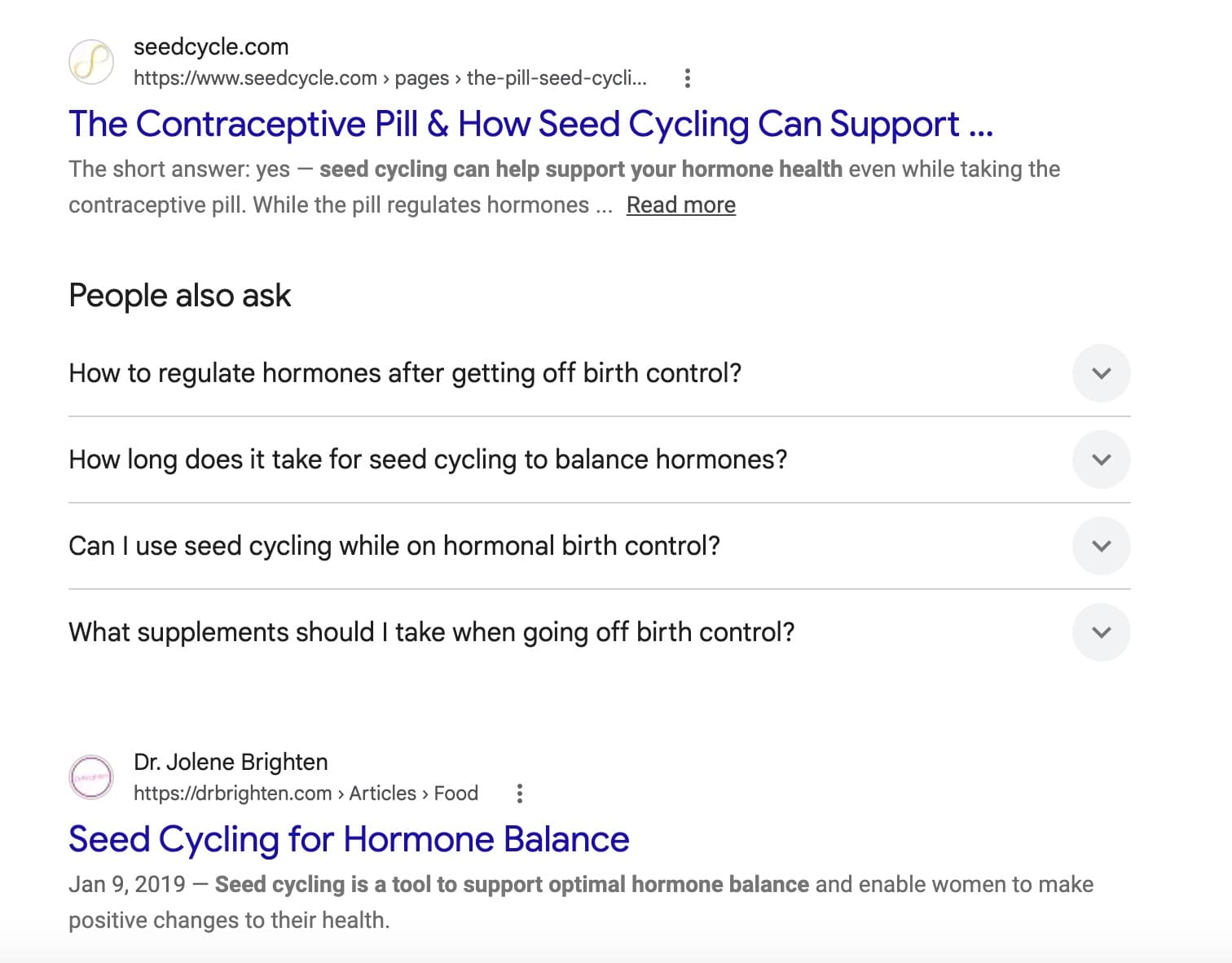
One practitioner ChatGPT recommended several times has roughly 125K Instagram followers — about one-third of the audience of the creator in this audit.
That's an important distinction for creator-led brands.
Having the biggest audience doesn't automatically make you the expert Google or AI surfaces when someone outside that audience asks a question. The advantage may go to the expert who has built an owned, discoverable library around the questions they want to be known for.
And that's what makes this gap so interesting.
Her own course tells us that post-birth-control hormone support, cycle regulation, fertility, cycle syncing, PCOS, endometriosis and PMDD are part of the expertise behind the business.
But when someone goes looking for that expertise outside of Instagram, there isn't yet a corresponding library of owned content helping them find her.
That's the Authority Gap in action.
Her gap wasn't audience. It was searchable authority. Her expertise lives on social media, where AI can't easily connect it to the questions her audience asks.
I compared the brands mentioned in the AI results
Six accounts in this niche, sorted by article count (low to high) — same order in all four panels. The "Instagram Followers" order scrambles while "Blog Articles," "Organic Keywords" and "AI Overview Share" all climb together. Followers / Articles / Keywords are log scale; AI Overview Share is 0–100%. Every bar carries its real value.
Instagram Followers
Scale: 100 – 1,000,000
Blog Articles
Scale: 1 – 1,000
Organic Keywords
Scale: 10 – 100,000
AI Overview Share
Scale: 0 – 100%
The full comparison
Every number pulled for this audit, side by side — search visibility, content library size, backlink authority, and how much of each topic AI already answers.
| Account | IG followers | Articles | Organic keywords | Est. traffic/mo | Authority score | Referring domains | AI Overview share |
|---|---|---|---|---|---|---|---|
| Her account | 413,000 | 18 | 20 | 6 | 12 | 239 | 0% (0 of 20) |
| Seed Cycle | 1,052 | 35 | 86 | 27 | 8 | 276 | 91% (78 of 86) |
| Mooncycle Seed Co. | 3,228 | 68 | 114 | 55 | 12 | 224 | 87% (99 of 114) |
| Funk It Wellness | 18,856 | 145 | 970 | 1,384 | 25 | 461 | 96% (928 of 970) |
| Nicole Jardim | 125,225 | 144 | 2,144 | 1,245 | 30 | 1,035 | 96% (2,063 of 2,144) |
| Dr. Jolene Brighten | 658,505 | 233 | 56,432 | 58,093 | 44 | 4,280 | 98% (55,498 of 56,432) |
AI Overview share is the share of each account's own ranking keywords where Google now shows an AI Overview at the top of the results page — how AI-mediated this topic has already become, independent of who gets cited inside it. Instagram followers via Social Blade / HypeAuditor; articles via each site's live XML sitemap; keywords and AI Overview share via Semrush — all pulled or captured September 2026.
Is this a technical SEO problem?
Slightly, but not entirely. There are fundamental SEO issues, like all 74 pages having the same meta description, but these are easy fixes that are always addressed at the beginning of an engagement.
Structured data doesn't create authority by itself, nor does it guarantee rankings or AI citations. But used appropriately, it can help machines understand certain information on a page more clearly, and right now, there isn't any.
This isn't a website that needs to be torn down and rebuilt. It needs a stronger authority layer built around the expertise she already has.
Starting with Published Video vs. Keywords
A traditional content strategy typically starts with target keywords and creates from there, however, the creator eco-system flipped that strategy entirely. Creators and business owners figured out that it's much less effort to pick up a phone and record versus writing out a thousand word article.
The elimination of written content has a detrimental effect on search potential, and that's the gap I continue to see in my practice.
With the creator economy, videos are first, articles are second.
Instead of starting with keywords, I look at clients existing content library to see where video topics capture high intent search keywords and questions.
The question isn't "What should she start writing about?" It's "Which of the things she's already teaching deserve a permanent home?"
That's a very different way to approach SEO and AI visibility. And it's the starting point of our Content Authority and Visibility Accelerator (CAVA Method).
Does every Reel need to become an article?
Not every reel needs to be an article, and this is where content repurposing often goes wrong.
Taking every Instagram video, writing 1,500 words and publishing it as a blog post isn't a content strategy. Some posts are meant to entertain. Some are personal. Some build connection. Some sell. Some answer a question that's too small to warrant an entire article.
But there are golden nuggets that can either become the start of a bigger guide or answer a high intent search directly.
The goal is to identify the ideas sitting at the intersection of:
What could ONE Instagram post actually become?
Let's do a real example to show the power of what one Instagram post could become.
Pulled directly from her Instagram grid is a seven-slide carousel about seed cycling. It explains what seed cycling is, who might be interested in it, breaks down the seeds used during the follicular and luteal phases, discusses their nutrients and connects the practice to concerns like fertility, PCOS, PMS, perimenopause and cycle regulation.
The post earned roughly 3,100 likes — more than twice the ~1,400-like average across the recent posts we sampled — plus dozens of comments from people asking to get started.
This is her bread and butter. Her audience was built around this topic.
The search demand is already there.
First things first, SEO is not dead. According to SparkToro and Datos, it's estimated that Google handled ~14 billion searches per day, compared with about 37.5 million search-like queries per day on ChatGPT — meaning Google was receiving roughly 373× as many searches as ChatGPT at the time of the analysis.
In today's landscape, you need to look at multiple factors to determine success of an article. I tend to start by looking at the search term data. This particularly gives me clues on topics that aren't extremely saturated. The difficulty number tells you how easy it would be to rank.
Considering the website authority is low, we need to target keywords with difficulty under 40. The chart below are all attainable keywords to rank for, and will be the building blocks of growing her authority to Google.
| Keyword | Monthly searches | Difficulty |
|---|---|---|
| seed cycling | 14,800 | 38 |
| seed cycling chart | 1,900 | 14 |
| seed cycling for hormones | 880 | 26 |
| seed cycling for fertility | 590 | 13 |
| seed cycling for menopause | 390 | 22 |
| seed cycle for hormonal balance | 260 | 24 |
| seed cycling period | 170 | 23 |
| does seed cycling work | 170 | 25 |
| seed cycling benefits | 140 | 19 |
Keyword data pulled from Semrush, September 2026.
She doesn't just talk about seed cycling. She sells a product built around it.
Now we have the intersection CAVA is looking for:
That's an authority seed worth cultivating.
So what do we build?
I'd use the original content as the foundation for a comprehensive authority asset, lessening the time the creator needs to revise and review.
The first asset: Seed Cycling: A Food-First Guide for Beginners
Much of the expertise already exists in the carousel.
The article can preserve her explanation of seed cycling, the follicular and luteal phase breakdowns, the specific seeds she recommends and the nutritional reasoning behind them.
But an authority asset gives us room to answer the questions Instagram can't.
- What if your period is irregular or absent?
- Can seed cycling support fertility?
- What about PCOS or perimenopause?
- How do you actually start?
- How long do people typically follow the practice?
- What does the research say about seed cycling?
- Does seed cycling actually work?
That last question is particularly important.
Rather than avoiding skepticism, this is an opportunity to address it directly: distinguish between what research supports, what is based on nutritional mechanisms, what remains uncertain and where claims may be overstated.
That's the kind of nuance that turns a promotional piece of content into something genuinely useful.
And it's exactly where her expertise matters.
Then one authority asset becomes a content ecosystem.
The keyword research doesn't just validate the pillar article. It tells us what people want to know next.
The original seed cycling post could eventually support resources such as:
- Seed Cycling for Fertility
590 searches/month | KD 13 - Seed Cycling for Hormones
880 searches/month | KD 26 - Seed Cycling for Menopause
390 searches/month | KD 22 - Does Seed Cycling Work? What the Research Says
170 searches/month | KD 25 - Seed Cycling Chart: What Seeds to Eat During Each Phase
1,900 searches/month | KD 14
Now we're not turning one Instagram post into one blog post.
We're using one proven idea to begin building a connected body of expertise around a topic that matters to her audience and her business.
And every piece can work together.
The original Instagram post doesn't go away. Its hook, visuals, engagement and comment-to-DM strategy are already working.
We're adding something it can't do:
Reach the person who doesn't follow her yet.
Someone searching “seed cycling for fertility” on Google.
Someone asking an AI platform whether seed cycling actually works.
Someone looking for a seed cycling chart.
Someone researching products that make seed cycling easier.
Those people aren't in her feed yet.
But they're already looking for what she knows — and what she sells.
That's the difference.
She doesn't need me to invent a new content strategy for her.
She already created the seed. CAVA turns it into something that can keep growing.
And what happens when AI recommends a product?
This is where discoverability becomes a commercial opportunity.
Someone could ask an AI platform:
“Are there any food-based products designed around cycle syncing?”
That person may have never heard of this brand, followed the founder or seen one of her Instagram posts. They're simply asking AI what they should consider buying. AI then scans the web for credible options.
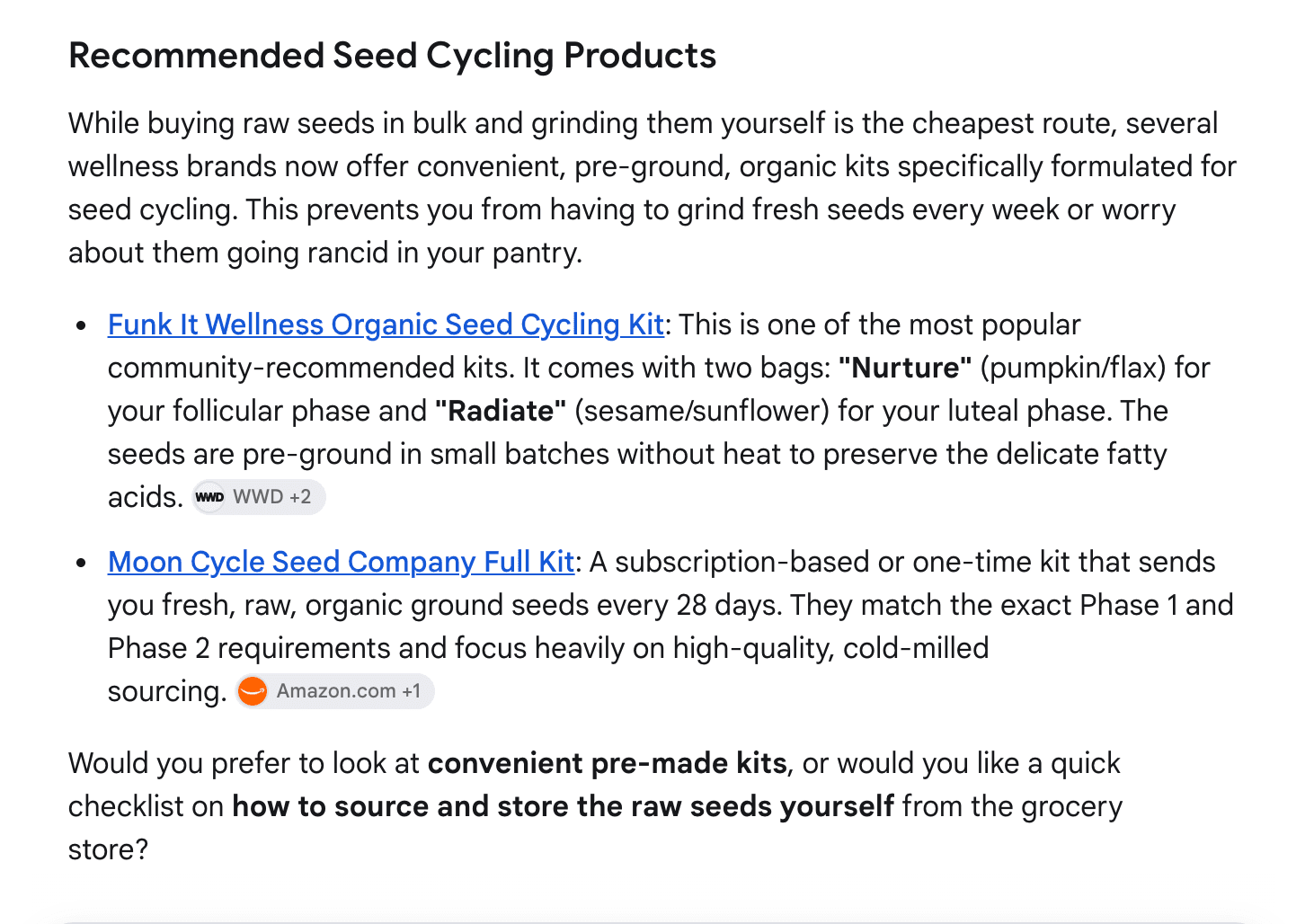
Funk It Wellness, one of the products AI Mode recommended, is a direct competitor, and it's a keyword that registers on her site. They have under 20k followers on Instagram, yet drive way more traffic to their website per month through organic and AI search.
By July 2026, Adobe reported that AI-referred traffic to U.S. retail websites had increased 62% year over year and was converting 60% higher than non-AI traffic.
That's particularly relevant here because she doesn't just teach seed cycling. She sells a product built around it.
The opportunity isn't simply to optimize the product page. It's to build credible educational context around seed cycling, cycle health, nutrition and her methodology so people, and the systems helping them research, can understand how the expertise and product fit together.
The educational content creates context around the product.
And suddenly those ~2,000 Instagram posts don't just represent social content. They represent potential entry points into the business that haven't been built yet.
Could search reveal content she hasn't created yet?
One of the pillars of our CAVA Method is doing the research to give creators a list of keywords and topics to use for future videos. These not only meet high intent search demand, but fill in content gaps that continues to build authority on the website.
This helps creators make strategic content without guessing or trying to think of new ideas. It's a bank of ideas that are proven to be highly searched and valuable to her audience specifically.
So what would I actually do for this creator?
This is exactly the kind of Authority Gap I built the CAVA Method — Content Authority and Visibility Accelerator — to solve.
Rather than asking this creator to produce even more content, I start with cataloguing and auditing the expertise she's already created across Instagram, YouTube, her website, products, courses and other educational materials.
From there, CAVA helps us identify which ideas have the strongest overlap between:
Then we turn those opportunities into connected authority assets designed to be discovered through Google and AI, while creating natural pathways into the products, programs and community she's already built.
The seed cycling example is exactly what that looks like in practice: find a proven idea, validate the opportunity, build it into something permanent, connect it to the business and let that authority compound.
We're not trying to turn 2,000 Instagram posts into 2,000 articles.
We're identifying the most valuable expertise inside those posts and giving it a permanent, discoverable home.
Does this model actually work?
We've already seen what can happen when expert content is given a more discoverable home.
For a Mudra client — a London consultant dermatologist — we used existing expertise as the foundation for search-focused authority assets.
Within 90 days:
- Organic clicks increased 403%
- Search impressions increased 1,051%
- Six of the site's ten highest-performing pages came from repurposed authority content
- ChatGPT began referring visitors directly to the website
And 7 months later, the results continue to compound.
Those are that client's individual results, not a prediction of what this brand would achieve. But they demonstrate the principle behind the strategy:
You don't always need more ideas. Sometimes you need to make the expertise you've already created work harder.
The Real Opportunity
This creator has already built the audience, established trust, created the products and produced thousands of pieces of content.
That's why I don't look at this website and see a brand that simply “needs SEO.”
I see years of intellectual property that haven't been fully activated yet.
Instagram can continue doing what it does incredibly well: build the audience.
The website can become the place where that expertise compounds — where Google can discover it, AI systems can potentially reference it, other websites can link to it and people who have never heard of the creator can find their way from a question to her expertise, products, course and community.
Social authority doesn't automatically become discoverable authority. But the expertise is already there. The opportunity is to make sure it's found.
Commonly Asked Questions
Do I really need to create more content, or am I underusing what I've already created?
If you've spent years creating educational content on social media, you may already have more than enough ideas. Start by identifying your strongest posts, recurring topics and audience questions, then turn the best opportunities into permanent, searchable resources. Our free Content Visibility Score can help you identify where to start.
How do I know which Instagram posts should become articles?
Look for the overlap between your expertise, audience engagement, search demand and business relevance. Not every post deserves an article. Prioritize ideas that already resonate with your audience and have a reason to be discovered by people who don't follow you yet.
Should I write about what performs well on Instagram or what people search for?
Both. Social engagement tells you what resonates with the audience you already have, while search data reveals what people outside that audience are actively looking for. Some of the strongest content opportunities appear where those two overlap.
Can I turn Instagram posts and Reels into articles without just repeating myself?
Yes. Treat the social post as the seed, not the finished article. Expand the original idea with deeper explanations, supporting evidence, related questions, expert insight and useful connections to other resources. The goal isn't to copy a Reel into a blog post; it's to build on the expertise already inside it.
Is blogging still worth it if people are using AI instead of Google?
Yes. Google remains a massive discovery channel, while AI is creating an additional way for people to research questions, experts, products and solutions. An owned body of useful expert content gives your brand more opportunities to be discovered across both.
How do I use keyword research without letting keywords dictate my content strategy?
Start with what you actually know and teach, then use keyword research to understand where demand exists around that expertise. Keywords should help you prioritize and expand your ideas — not dictate what you're qualified to talk about. Think expertise first, search data second.
________________
Sources
- Semrush Domain Overview — subject domain, audited August 26, 2026
- Full-site technical crawl — 92 pages, audited August 26, 2026
- Instagram grid sample — 36 posts, audited August 26, 2026
- Semrush keyword research — US database, audited August 26, 2026
- Instagram follower and engagement check — audited September 21, 2026
- ChatGPT, Perplexity and Google prompt experiment — run September 22–23, 2026
- Semrush, ChatGPT Traffic Analysis: Insights From 17 Months of Clickstream Data
- Adobe Digital Insights, Generative AI-Powered Shopping Rises With Traffic to U.S. Retail Sites
- Adobe Digital Insights, July 2026 AI referral traffic data (via Digital Commerce 360)
- Kaiser & Schulze, ChatGPT Referrals to E-Commerce Websites: How Do LLMs Compare Against Traditional Channels?, Marketing Science, 2026
- Mudra Marketing Group, Dermatology SEO Case Study
- SparkToro and Datos, New Research: Google Search Grew 20%+ in 2024; receives ~373X more searches than ChatGPT
This is a prospective analysis based entirely on publicly available information. The brand analyzed is not a Mudra Marketing Group client, and no CAVA work has been performed for it. Data reflects a 36-post Instagram sample, a 92-page website crawl and domain-level SEO research, all dated August 26, 2026, except for the follower and engagement figures (checked September 21, 2026) and the AI platform experiment (run September 22–23, 2026). Search volumes, rankings and traffic figures are third-party estimates and may change over time. Results cited from other Mudra clients are their individual results and are not projections or guarantees.